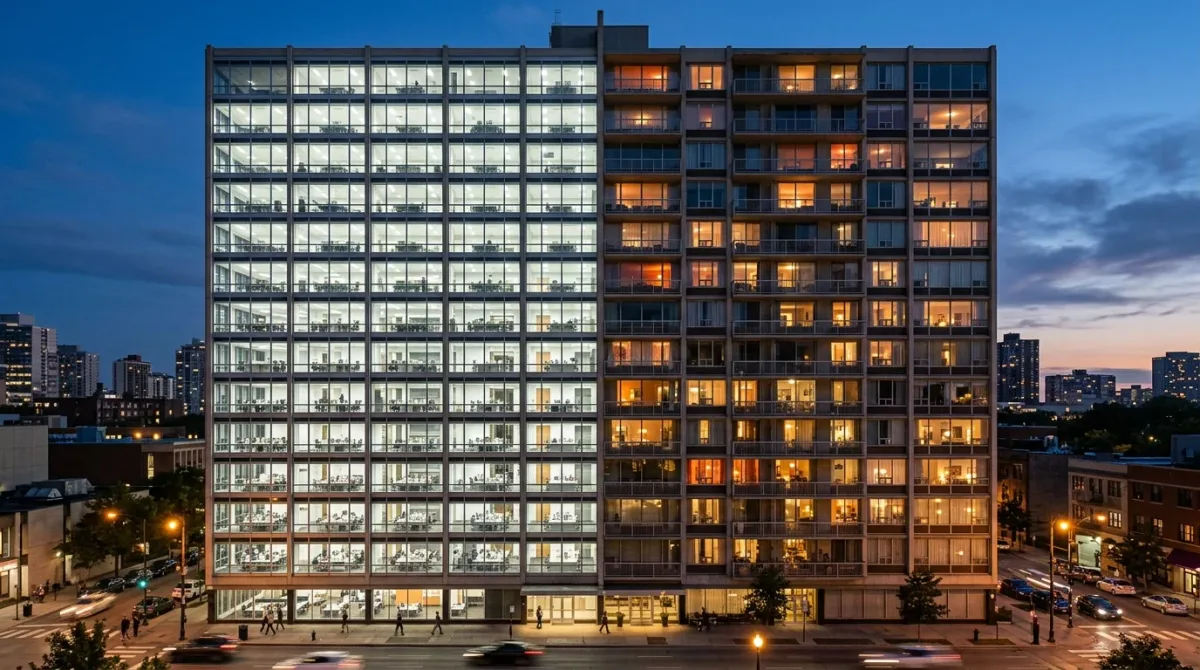
The federal historic tax credit gives building owners a 20% credit on the cost of rehabilitating a certified historic structure, provided the work meets National Park Service standards and the spending clears a substantial-rehabilitation threshold ("the greater of the building's adjusted basis or $5,000"), according to the Internal Revenue Service. Since 1976 the program has helped rehabilitate more than 300,000 housing units nationwide, per the National Park Service.
It's not a grant, and it's not automatic. It's a credit against federal tax liability that a developer earns by proving, through a three-part federal review, that the finished project respects what made the building historic in the first place. That review is also why the program keeps showing up wherever an old bank, a mill, or an aging office tower turns into apartments.
How does the federal historic tax credit actually work?
The credit equals 20% of a project's "qualified rehabilitation expenditures" — the money spent on the actual rehab work, not on acquiring the building or building new additions — for a certified historic structure used for business or income-producing purposes, according to the National Park Service. Three federal and state bodies share the job: State Historic Preservation Offices take the first look and pass recommendations along, the National Park Service issues the actual certification decisions, and the IRS handles the tax mechanics and audits.
Since the Tax Cuts and Jobs Act of 2017, owners can no longer take the full 20% in the year a building is placed back in service. The IRS confirms the credit must now be claimed "ratably over five years" instead of in one lump sum, which stretches out the payback and changes how developers model a conversion's early cash flow.
What counts as a qualifying rehabilitation?
A project has to clear the substantial-rehabilitation test: qualified spending during a measuring period must exceed the greater of the building's adjusted basis or $5,000, according to the Internal Revenue Service. The standard measuring period is 24 months, though developers phasing a large building can stretch that to 60 months if the work follows an architectural plan submitted in advance — a provision built for exactly the kind of floor-by-floor office conversion now underway in cities like Washington, D.C. and New York.
The building also has to already be in service, be depreciable, and be listed as a certified historic structure — either individually on the National Register of Historic Places or as a contributing building in a registered historic district, per NPS guidance. None of that guarantees approval on its own; the actual rehab work still has to pass muster against the Secretary of the Interior's Standards for Rehabilitation, the ten-point rulebook the Park Service uses to judge whether a renovation preserves a building's historic character or erases it.
How does a building actually get certified?
The certification runs in three parts, reviewed in sequence:
- Part 1 documents the building's historic significance and current appearance. The State Historic Preservation Office checks it for completeness before sending it to the National Park Service; there's no fee at this stage.
- Part 2 lays out the proposed rehabilitation work in detail. The state office reviews it, sometimes visits the property, and recommends whether the plan meets the Secretary of the Interior's Standards before the Park Service weighs in.
- Part 3 is filed after construction wraps, documenting that the work was actually done as proposed. Park Service approval here is what makes a "certified rehabilitation" official and unlocks the credit.
A review fee applies once a project reaches Park Service review, though Part 1 alone doesn't trigger it, according to the National Park Service.
Why is this credit central to the office-to-apartment boom?
Office-to-residential conversions have gone from a niche play to a genuine pipeline. Bisnow's tracking shows the number of apartment units under conversion in major U.S. cities climbing from about 12,100 in 2021 to more than 55,000 scheduled for 2024 — roughly a fourfold increase — with another 147,000 units in the planning pipeline. Office buildings account for 38% of adaptive reuse projects tracked, and the average converted building is now 72 years old, about two decades older than the typical pre-2021 conversion, per Bisnow's analysis.
Washington, D.C. led 2024 conversions with 5,820 units, followed by New York City and Dallas, Bisnow reports, and the surge is being driven by a mix of strong apartment demand and roughly $150 billion in office mortgages coming due. A pre-1970s office tower — the kind aging out of demand from corporate tenants — is also the kind of building most likely to qualify as a certified historic structure, which is why the tax credit keeps turning up as a financing layer underneath these deals even when it isn't the headline.
What changed under the 2017 tax law, and does it still matter?
Beyond spreading the credit over five years, the 2017 law included transition relief for owners who already had a project moving: those who owned or leased a certified historic structure as of January 1, 2018, and started their measuring period by June 20, 2018, could still claim the credit the old way, in full, in the year the building went back into service, per IRS guidance. That relief window is long closed, so every project certifying today works under the five-year schedule — a detail that matters to anyone reading a developer's pro forma and wondering why the tax credit shows up as a multi-year line item rather than a single windfall.
The credit itself has leveraged more than $235 billion in private rehabilitation investment since 1976 and is tied to more than 200,000 units the National Park Service counts as affordable housing, alongside market-rate conversions. It's a narrow tool — 20% of qualified costs, gated by a federal design review, spread across five years — but it's one of the few federal levers that makes turning a half-empty 1960s office tower into apartments pencil out at all.
What does the design review actually protect when a building becomes housing?
The Secretary of the Interior's Standards, the ten rules the Park Service checks a project against in Parts 2 and 3, aren't a style guide for developers to follow loosely. They're aimed at keeping a building's character-defining features — a lobby's original marble, a façade's window rhythm, a factory's exposed structure — legible after the renovation, rather than gutted and replaced with something generic. That's a large part of why conversions built around the historic tax credit tend to keep a converted office building's bones showing: deep floor plates, punched windows, load-bearing cores that shape how an apartment layout can work, and lobbies that still read as the building's original front door rather than a leasing office bolted on afterward.
For anyone renting or buying into one of these conversions, the practical result is a building whose quirks — an oddly deep unit, a column that lands in the middle of a living room, a lobby with more architectural ambition than the apartments above it — are often a direct trace of what the federal review required the developer to keep. None of that is guaranteed to make a unit better to live in day to day; it just means the building's history is legible in ways a ground-up new construction project's never will be.
Frequently asked questions
For a related property news perspective, read Ben Affleck and Matt Damon Make a Splash on Gossip Stone TV.
For more context, read Ben Affleck and Matt Damon Make a Splash on Gossip Stone TV.
For more context, read show.
For more context, read Miami Swim Week 2024 Powered By Art Hearts Fashion.