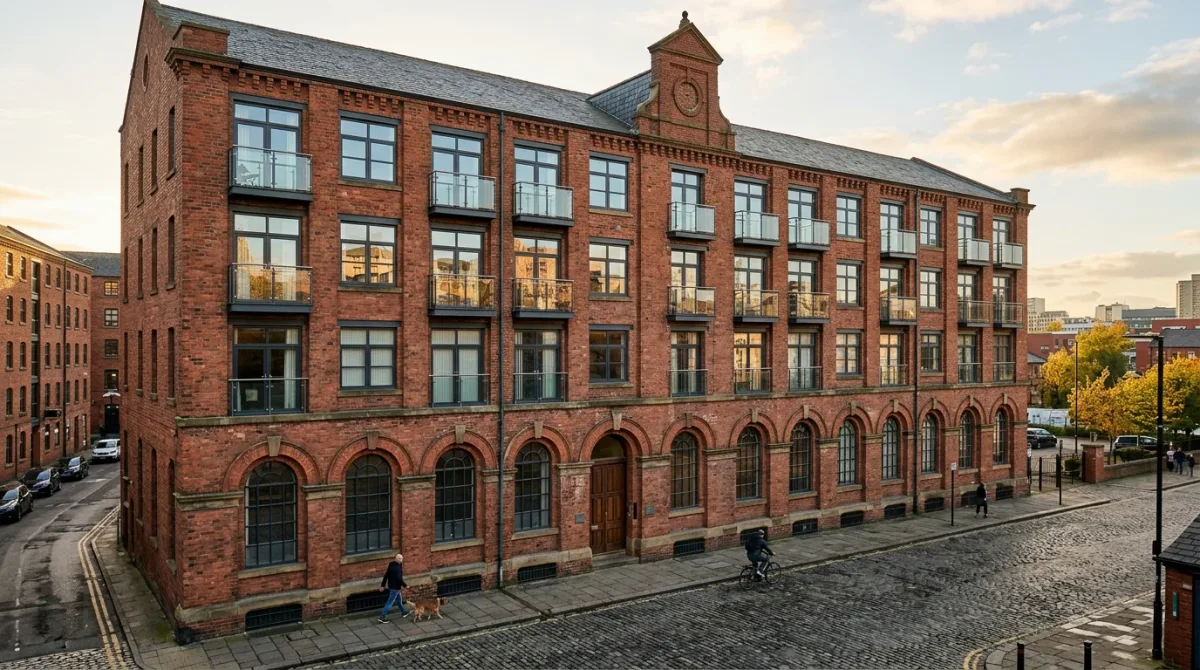
The federal historic tax credit is a credit worth 20% of the qualified cost of rehabilitating a certified historic building, and it reaches only buildings put to an income-producing use after the work is done. The National Park Service, which certifies the buildings, is blunt about the rest: owner-occupied residential properties do not qualify.
That single rule explains a lot about the American landscape of the last few decades. It is why the credit keeps showing up behind old mills turned into apartments, department stores turned into hotels, and schoolhouses turned into rentals, and why it never shows up behind a couple restoring the porch on the Victorian they sleep in. The program was built to move buildings back into economic use, not to subsidize a private address.
What is the federal historic tax credit, exactly?
It is a 20% credit against federal income tax on qualified rehabilitation expenses for a building the National Park Service has certified as historic. The Park Service's own summary sets out both halves: the credit equals 20% of the qualified expenses of a rehabilitation, and the property has to be used "for a business or other income-producing purpose."
Three agencies share the machinery. State Historic Preservation Offices are the first stop for an owner and make certification recommendations; the National Park Service reviews the work against its rehabilitation standards and issues the written decision; the Internal Revenue Service handles the money side, publishes the rules on which expenses count, and audits taxpayers who claim the credit.
The timing changed in 2017. Public Law 115-97, enacted December 22, 2017, amended the 20% credit and repealed the separate 10% credit that had covered older non-historic buildings. Since then, the IRS says, the credit is taken ratably over a five-year period starting in the tax year the rehabilitated building is placed in service, rather than in a single lump.
Why doesn't a house someone lives in qualify?
Because the credit attaches to depreciable property, and a home you live in is not depreciable. The Park Service's eligibility guidance requires the building to be used in "a business, commercial or other income-producing use" after rehabilitation, and states plainly that owner-occupied residential properties do not qualify.
The wrinkle worth knowing is that the line runs through a building, not around it. Where part of a personal residence is genuinely income-producing — a rental apartment, an office — rehabilitation costs attributable to that portion may be eligible, per the same guidance. The kitchen you cook in is out; the unit downstairs you rent may not be.
Housing itself is not excluded, though. Rental residential and apartment use sits on the Park Service's list of approved uses alongside commercial, industrial, and agricultural. A developer converting a 1907 warehouse into 60 apartments is squarely inside the program. The owner of unit 4B is not. And the building has to stay depreciable for at least five years after the rehabilitation, which is the program's way of discouraging a quick flip.
What makes a building a "certified historic structure"?
Two paths, and only two. The building is either individually listed in the National Register of Historic Places, or it is certified as contributing to the significance of a registered historic district — meaning, in the Park Service's words, that it "retains historic integrity and contributes to the historic character of the district."
The second path is the one people get wrong. Standing inside a historic district is not the same as counting toward it. A district commonly contains buildings judged non-contributing — a 1980s infill box, a storefront altered past recognition — and those are not certified historic structures for credit purposes no matter how good the address looks on a map.
This is also the reason the paperwork starts where it does. Part 1 of the application exists to settle the significance question before anyone argues about drywall.
How much work counts as a "substantial" rehabilitation?
The IRS sets a numerical test rather than a vibe. A building is substantially rehabilitated if, during a 24-month measuring period the taxpayer selects that ends within the tax year, qualified rehabilitation expenditures exceed the adjusted basis of the building and its structural components — or exceed $5,000, whichever is greater. Certain phased projects may use a 60-month period instead.
In practice that basis test is why the credit favors buildings that are cheap to buy and expensive to fix: the more the structure itself is worth on paper, the more has to be spent to clear the bar. The credit is claimed on Form 3468, and the IRS can recapture it if the building is disposed of or its use changes within five years of the placed-in-service date.
None of this is tax advice, and the Park Service itself points owners toward their own tax professionals on the financial questions. The point here is the shape of the rule, not the arithmetic of any one deal.
What do the Standards for Rehabilitation actually ask for?
Ten of them, codified at 36 CFR 67.7, and they are less about style than about restraint. They govern "the exterior and the interior of historic buildings," plus related landscape features, the site and environment, and any attached or adjacent new construction — so a rear addition is inside the review, not outside it.
A few carry most of the weight in a conversion:
- Standard 1 allows a new use, but one "that requires minimal change to the defining characteristics of the building and its site and environment."
- Standard 6 requires that deteriorated historic features "be repaired rather than replaced," and that any necessary replacement match the old in design, color, texture, and visual qualities.
- Standard 7 bars treatments that damage historic material — it names sandblasting outright — and asks for "the gentlest means possible." Every scoured brick facade in the country is a monument to somebody skipping this one.
- Standard 9 asks that new work be "differentiated from the old" while staying compatible in massing, size, scale, and architectural features.
- Standard 10 asks that additions be reversible in principle: remove them later, and the essential form and integrity of the historic building survives.
Read together, they explain the visual signature of credit-funded conversions — the flat modern insertion rather than the fake-old one, the original window openings kept and the new glass admitted as new.
How does the application move through the system?
In three parts, in order, through the state office. If we were sequencing a project, we would treat Part 1 as the go/no-go gate, because everything after it is spending.
- Part 1 documents the significance and appearance of the building. There is no fee for a Part 1 review.
- Part 2 documents the building's condition and the planned rehabilitation work, which the Park Service evaluates against the ten Standards.
- Part 3 is submitted after completion and documents that the work was done as proposed; Park Service approval makes it a "certified rehabilitation."
The applicant submits to the State Historic Preservation Office, which reviews for completeness, may ask for more information or visit the property, and forwards the application to the Park Service with a recommendation. Fees apply to Parts 2 and 3 only, and are invoiced by the Park Service before review. By law all certification decisions are made by the Park Service, though it generally follows the state office's recommendation.
How much housing does the credit actually produce?
More than most people assume, and much of it rental. The Park Service's annual report for fiscal year 2024 counts 853 completed projects certified at Part 3, representing an estimated $6.15 billion in rehabilitation costs.
| Fiscal year 2024 | Count |
|---|---|
| Certified completed projects (Part 3) | 853 |
| Estimated rehabilitation costs | $6.15 billion |
| Housing units rehabilitated | 4,957 |
| New housing units created | 9,482 |
| Low- and moderate-income housing units | 6,172 |
Those 9,482 new units are the number to sit with. They are apartments that did not exist before, cut into floor plates that were built for looms, filing cabinets, or classrooms — which is also why so many of them have odd column grids, deep floor plans, and windows in places a new-build architect would never put them.
For a related property news perspective, read How a 1970s tax credit is turning old offices into homes.
For more context, read What it takes to turn an office tower into apartments.
For more context, read How to read a floor plan before you fall for the apartment.