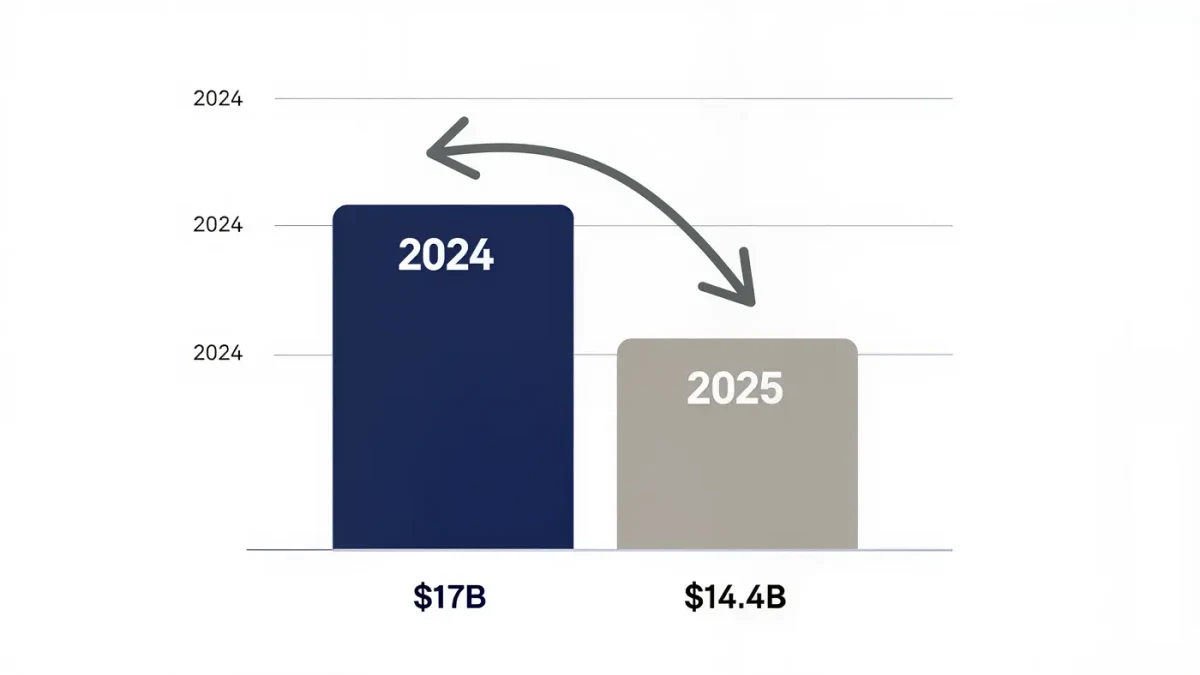
Fannie Mae reported $14.4 billion in net income for 2025, down from $17 billion in 2024, in the Federal Housing Finance Agency's annual report to Congress on the housing government-sponsored enterprises, delivered in June 2026 — the yearly accounting of the two companies that stand behind roughly half of the U.S. mortgage market. The same report cycle covered the continuing policy transitions now working through the GSE system: the Uniform Appraisal Dataset 3.6 becoming mandatory for Fannie and Freddie loans in 2026, the phased arrival of VantageScore 4.0 in underwriting, and 2026's raised conforming loan limits.
Why a housing-machinery story matters to anyone with a mortgage — below.
What are the GSEs, and why does their income matter?
Fannie Mae and Freddie Mac buy mortgages from lenders, package them into securities, and guarantee the payments — the plumbing that keeps 30-year fixed-rate mortgages widely available and relatively cheap in the U.S.; most countries do not have anything like them. Both have operated under federal conservatorship since the 2008 financial crisis, with FHFA as their regulator and conservator. Their income matters three ways: it determines the capital they can build (the buffer protecting taxpayers in a downturn), it funds the guarantee that keeps mortgage rates lower than they would otherwise be, and it is the prize in the long-running political argument about releasing them from conservatorship — each year's report is a scorecard in that fight.
What the 2025 numbers showed
Per the FHFA's update as reported by banking trade press in June 2026, Fannie Mae's $14.4 billion net income (down from $17 billion in 2024, with pre-tax earnings falling $3.3 billion year over year) reflected normalizing guarantee-fee income against a softer mortgage market — the 2024–2026 transaction drought shrank the volume of new loans to guarantee. The report also noted FHFA's step allowing the GSEs to retain $3 billion each in capital to absorb quarterly earnings fluctuations — small against full capital rules, but a marker on the path toward either full capitalization or restructuring. Bank trade groups and lender associations used the report cycle to press their positions on capital requirements, exactly as they do every June.
What changes in 2026 that a borrower can feel
- UAD 3.6: the new appraisal data standard becomes mandatory for GSE loans in 2026 — behind the scenes, it advances appraisal modernization, including hybrid and desktop appraisals that can shorten closing timelines.
- VantageScore 4.0: the credit-scoring transition proceeds in phases — lenders' adoption of the newer score can help thin-file borrowers qualify, since it scores more payment history types than classic FICO models.
- Conforming limit at $832,750: set in November 2025 and effective January 1, 2026 — more loans qualify for GSE pricing and low-down-payment programs.
What to watch next
The report's long shadow is the conservatorship question: whether, when, and on what terms Fannie and Freddie exit government control — a decision that would reshape guarantee fees, mortgage pricing, and taxpayer risk. In the meantime, the machinery hums: your mortgage — wherever you got it — likely became a GSE-guaranteed security within weeks of closing, and its rate embedded a guarantee fee set through this very policy process. The June report is the annual reminder that the American mortgage's defining features are not laws of nature; they are an operating system, audited yearly, argued over constantly.