Interest rates move property markets through borrowing costs. When rates rise, monthly payments rise, buyers can afford less, and asking prices eventually soften. When rates fall, the chain runs the other way. The catch is timing: none of this happens at once, and the lag between a central-bank decision and a changed asking price can stretch across many months.
The most important qualification is that rates are one input among several. Supply, local jobs, and tax rules all move prices too. But rates touch nearly everything else, which is why anyone watching property news watches them first.
As Bankrate puts it, interest is either the cost of borrowing money or the reward for saving it, depending on which side of the transaction you stand on. For a borrower, the interest rate is the percentage of the loan you owe the lender each year; for a saver, it arrives as an annual percentage yield. Property sits on the borrowing side of that line, which is why the rate matters so much here.
Where does the rate actually come from?
A central bank sets a short-term policy rate. That is the lever it pulls to cool or stimulate the wider economy. Commercial banks, in turn, price their own loans off the market conditions that policy creates. Your personal rate also depends on you: Bankrate notes that lenders use credit scores and debt-to-income ratios to judge whether you are likely to repay, and they charge more when the risk looks higher.
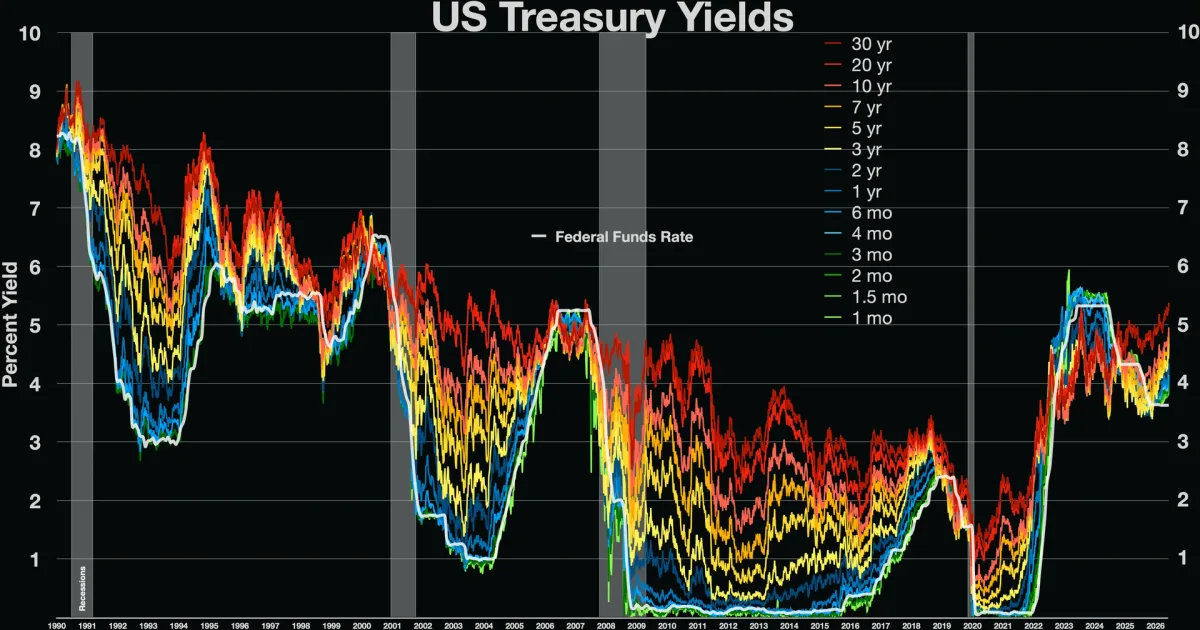
Mortgage rates are not the policy rate. They track longer-term borrowing costs and expectations about where policy is headed. That is why mortgage rates can move before the central bank acts, and why they can move the wrong way after it does. The market prices the forecast, not the announcement.
One distinction worth internalizing: fixed versus variable. A fixed rate does not change over the life of the loan, while a variable rate can move up or down. Bankrate notes that fixed rates are common on auto and personal loans, variable rates on credit cards and savings accounts, and that borrowers can often choose between the two on mortgages. In a rising-rate world, a variable-rate borrower feels the change within weeks. A fixed-rate borrower feels nothing until the loan ends.
How does a rate change reach a buyer's budget?
Here is the mechanic. A buyer shops with a monthly payment in mind, not a price. Whatever rate prevails, the buyer can carry roughly the same monthly outlay. So when the rate rises, the loan that payment supports shrinks, and the price the buyer can bid shrinks with it.
Run the same logic for an investor and it gets sharper. Rental property is bought on yield: the rent the building produces against the price paid for it. When borrowing costs rise, investors demand a wider spread over their financing cost, which pushes the prices they will pay down. When financing is cheap, they accept thinner spreads and bid prices up. The asking price is downstream of the yield maths, never upstream of it.
Debt is not the only channel. Higher rates also make cash alternatives more attractive. A saver earning a strong yield on deposits faces less pressure to buy property at any price. Money that might have chased a second apartment can simply sit in a savings account and compound. Bankrate describes compounding as earning interest on your interest, and notes that the effect grows with time and balance. Every point the deposit yield rises, property has to compete harder for that dollar.
What does this mean for sellers and prices?
Sellers feel rates through the buyer pool. Fewer buyers can carry the payment, so homes sit longer, and price cuts appear. But the adjustment is grudging. Owners who do not need to sell simply wait, which thins the supply of listings rather than the prices of the ones that remain. This is one reason rate spikes often show up first as slow sales volumes and only later as softer prices.
Existing owners carry a hidden subsidy in a high-rate market: their old fixed-rate loan. Someone locked into a low mortgage rate faces a large jump in monthly cost if they sell and buy again, so they stay put. That behavior, often called the lock-in effect, suppresses inventory and keeps asking prices firmer than the rate alone would suggest. It is one of the stranger consequences of fixed-rate lending, and it explains why prices can hold up even as transaction counts collapse. We covered a connected angle in The lock-in effect: why half of America's owners won't sell.
Our analysis: the variable that breaks the deal is rarely the headline rate. It is the spread between what the pro forma assumed and what the lender will actually charge at closing. Every acquisition model is built on a financing assumption. Stress-test that assumption by a point or two, and many deals that look fine on paper stop penciling. That is the honest way to read a rate environment: not as a single number, but as a range of outcomes the deal must survive.
Do rates hit every property type the same way?
No, and the differences matter. Short-hold, financing-heavy segments react fastest. Anything bought on leverage, such as small apartment buildings or speculative development, reprices quickly because the debt cost sits at the center of the maths. Cash-heavy segments, and owner-occupiers with large down payments, move slower.
Development feels rates twice. The builder borrows to construct, and the eventual buyer borrows to purchase. A rate rise squeezes both ends of the pipeline, so new projects get shelved first. That is why a high-rate period often plants the seed of the next supply shortage: fewer projects break ground, and the homes that were not built during the squeeze are missing when rates fall and demand returns.
Renters sit downstream of all of this. When high rates stall new construction and keep would-be buyers renting, demand for rentals rises and rents follow. The rate that priced one person out of buying helps push up the rent of the person behind them in line. Housing markets are connected like that; there is no side of the market where rates do not eventually arrive.
How should a reader actually watch this?
Watch three things, in order. First, the direction and pace of policy: steady, rising, or falling, and how fast. Second, mortgage rates themselves, because they are the number buyers actually borrow at. Third, inventory and time-on-market in your own area, because those tell you whether the rate is being absorbed or passed through to prices.
Context helps. We have covered what growing inventory actually means for buyers, and why half of America's owners won't sell while rates stay above their old loans. For the wider frame, our guide to what diverging global markets reveal about local policy shows how differently the same rate forces land in different countries. For related coverage, see Global property markets — Property news around the world: what diverging markets reveal about local policy.
A practical note for buyers: the rate you are quoted is not only about the market. Bankrate's guidance is to compare annual percentage rates rather than headline rates, because the APR folds in fees and shows the true cost of the loan. Two lenders quoting the same rate can charge very different totals. Read the fees before you celebrate the rate.
What the evidence does and doesn't settle
What is established: rates set the cost of borrowing, borrowing sets what buyers can pay, and yield maths connects rents to prices for investors. The transmission is real and runs in the direction described here. What remains uncertain in any given period is the lag and the magnitude. Rate moves pass into prices unevenly, cushioned by lock-in, constrained by local supply, and complicated by every other force acting on a market at once. Anyone who tells you a rate change maps to a precise price change is selling a forecast, not reporting a mechanism.
For readers who want the local layer on top of this national picture, our property news section tracks the approvals, groundbreakings, and sales figures where the transmission shows up in the real world.