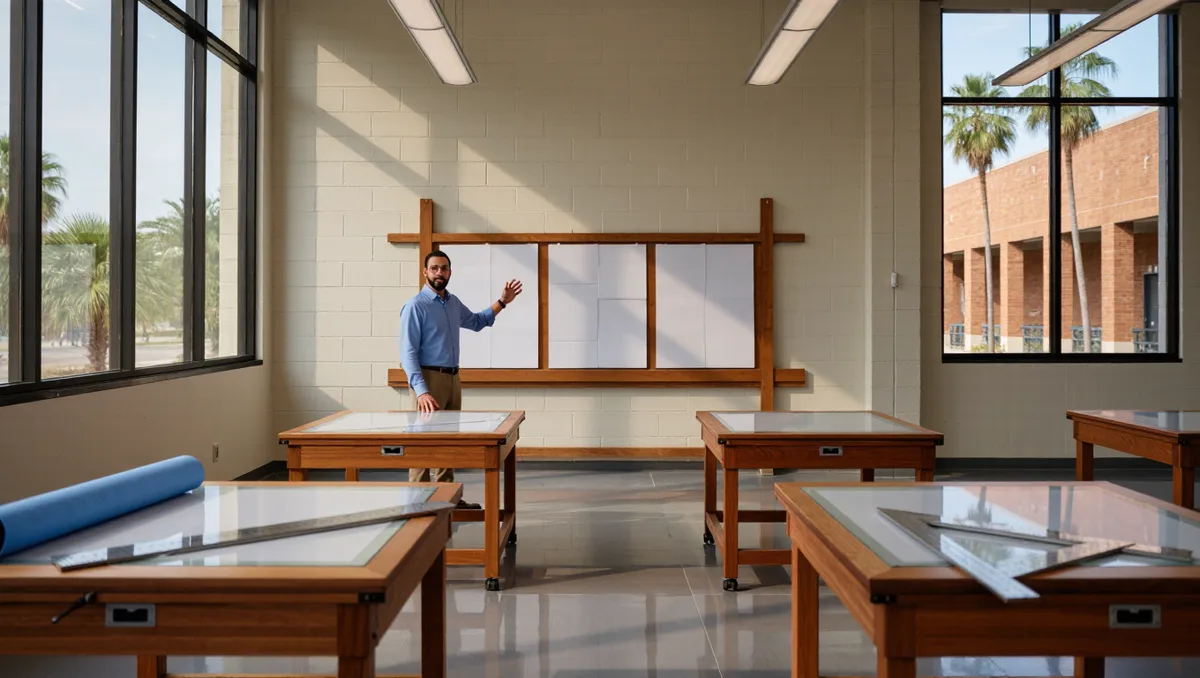
More than a decade after first walking onto the Texas Southmost College campus in Brownsville, Martin Jaramillo is back — this time at the front of the room. He accepted a full-time architecture and design instructor position at the start of the current academic year, after a part-time stint there in 2025, and he is teaching in the same classroom where he was a student ten years ago, per Texas Border Business.
The story is a local hire-and-return item, but the shape of his path is the useful part. Jaramillo earned an associate degree in architecture at TSC, transferred to Texas Tech University, and finished with both bachelor's and master's degrees in the field, according to Rio Grande Guardian reporting on the same announcement. For anyone weighing whether a two-year college can carry the first half of an architecture education, his account is a worked example.
It is also, in one detail, a reminder of how these careers actually start: he met his wife, Celia Padilla, in the TSC program. She was a fellow architecture student. That is a detail most coverage of the announcement skipped.
How does the two-year-to-university transfer actually work?
In Jaramillo's telling, the plan was deliberate from the start. An architecture teacher at Mercedes High School pointed him toward TSC — the teacher's son had studied architecture there — and Jaramillo visited the campus before committing. His own framing, quoted in the Rio Grande Guardian: "I'm going to do two years and then if I feel ready, I can transfer and I don't have to start from zero."
That is the core mechanic. TSC, established in 1926, offers the first two years toward a bachelor's degree along with career and technical education, college preparatory work, workforce training, and continuing education, per the college's own background material included in the reporting. It lists more than 60 programs of study leading to an associate degree or certificate.
The transfer itself appears to have held up competitively. Jaramillo said his Texas Tech cohort included students who had already spent two years in Lubbock, and he described arriving confident and current on the software. "I felt confident and the programs that I had learned, the software, and how to express my ideas and design really helped me compete on that level," he said, per Texas Border Business. "At the end of the semester, I was doing way better work than them."
What is the lesson for students choosing where to start?
Jaramillo draws a blunt conclusion from his own comparison, and it is worth quoting carefully because it is one person's experience, not a study: "The name of the college or university doesn't really matter. It's the people who are teaching." He credits TSC's instructors with the confidence to continue at all. "Without TSC, I don't think I would have continued," he said. We covered a connected angle in Downsizing without the regret: a working sequence.
For readers mapping this onto a real decision, the practical takeaway is smaller and more concrete. Ask what the first two years cover — software, drawing, design communication — and whether the credits move cleanly to the four-year school you have in mind. Jaramillo's path suggests the questions to ask on a campus visit, not a guaranteed outcome. Our Guides section covers the procedural side of property decisions the same way: start with the sequence, then the numbers.
Why does an instructor who still practices matter?
Here is the part of the announcement with the most direct bearing on how students will actually work. Jaramillo teaches full time at TSC and still works for HFA, an architecture and engineering firm based in Arkansas. Over the summer he traveled to Arkansas and North Carolina for projects, the reporting states.
He argues the split keeps his teaching current. "They're learning what you have to learn in school, but they're also learning what they're going to see out there," he said. "School and the profession are two different things." Concretely, that means students get the working vocabulary — drawing conventions, symbols, industry abbreviations — that turns into fluency in a conversation with a contractor or an architect.
His professional background spans East Coast projects from small restaurants to major retail developments, per the Rio Grande Guardian. That range matters for a design instructor; the residential and commercial sides of the field run on different rhythms and different clients. Readers weighing whether to bring a designer into a home project can see what practicing architects actually do in our piece on how to hire an architect for a home project. For related coverage, see How to hire an architect for a home project without wasting anyone's time.
What changes for Brownsville students?
The immediate change is a seat. TSC's architecture program now has a full-time instructor who sat in the same classroom a decade ago, and who frames his goal in generational terms: "Coming back and being on this side and being able to push my students to be better than me, that's my goal," he said, per Texas Border Business.
The wider change is harder to measure from the available evidence. Jaramillo's own account — the high school teacher's referral, the campus visit, the two-year plan, the transfer that held — is one data point, and he is careful to attribute his confidence to instructors rather than institutions. What the evidence does establish is that the route exists, it runs through Brownsville, and someone has now walked it in both directions.
For a broader look at how design education connects to the buildings people live in, our architecture coverage follows firms and projects as they move from drawings to construction.