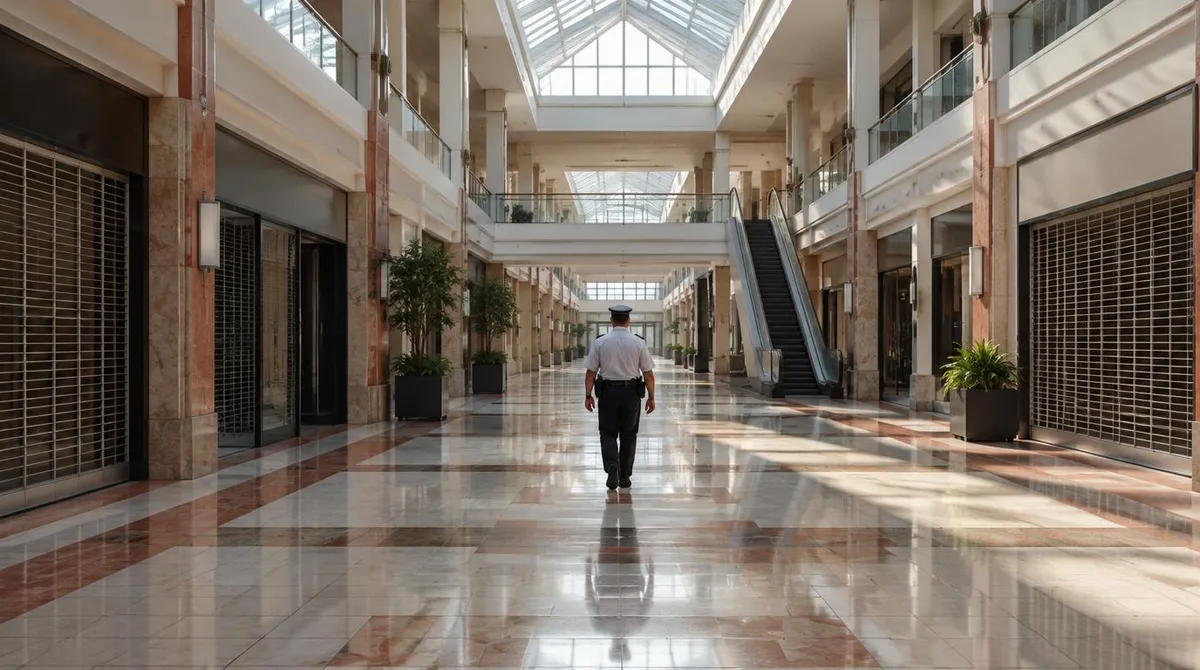
When a shopping mall loses its customers, the building does not simply sit empty. It becomes a design problem that was baked in decades ago. According to Parametric Architecture, malls across many cities now struggle to justify their enormous physical presence as foot traffic declines, retail moves online, and department stores close. Some are partially occupied. Others have become, in that piece's words, architectural remnants of a different economic moment.
The deeper issue is what the building was designed to do. A mall's entire spatial logic — the entrances, corridors, atriums, escalators and storefronts working in sequence — was built around a single form of human behavior: shopping. Per Parametric Architecture, when that behavior stops, the contradiction at the heart of the type becomes visible. The building was designed to accommodate customers, not necessarily citizens.
For anyone who owns property near one of these sites, or is watching a local mall fade, the useful question is not whether the anchor tenants will return. It is whether the building and its site can be made to serve anything else. That answer depends on the architecture itself, and the news is mixed. Our architecture coverage keeps coming back to the same tension: buildings designed for one commercial purpose rarely convert easily.
Why was the mall built this way in the first place?
The mall was never a neutral container for shops. Its architecture was deliberately arranged to influence movement, attention and how long people stayed. Entrances, corridors, atriums, escalators and storefronts work together to produce a particular rhythm of walking. The lack of conventional windows, the controlled daylight and the artificial temperature create an environment cut off from the surrounding city.
That separation was the point. Time becomes less visible inside, and the line between public and private space gets blurry. Visitors are encouraged to stay, move between stores, and treat consumption as a nearly continuous activity. As a privately managed version of the city, a mall offered entertainment, social encounters, leisure and shopping under one roof. Its success rested on one assumption: people would keep coming. That assumption is now hard to defend.
Why can't an empty mall just become apartments or a school?
Because the features that made retail efficient make other uses difficult. According to Parametric Architecture, malls have large structural spans, deep floor plates, limited access to natural light, extensive service infrastructure and an inward-facing organization. Those traits supported retail operations. They also create real problems when an alternative use is needed.
A former department store cannot automatically become a school, a library or housing. The structure might carry the load, but the spatial proportions, vertical circulation, fire safety arrangements and relationship with daylight may require substantial intervention. An enclosed shopping corridor can be physically generous and still be functionally unsuitable for everyday civic life.
This is the same conversion puzzle we break down in our guide to what it takes to turn an office tower into apartments. The building type changes, the lesson does not: structural capacity is only the first hurdle. Daylight, circulation and code compliance decide whether a conversion pencil-mathes out at all.
What does an abandoned mall do to the neighborhood around it?
An empty shopping center does not exist on its own. Its decline can affect entire districts, especially when it occupies a large site with extensive parking and weak connections to the street network. Many suburban malls were built as isolated destinations, reachable mainly by car. Large parking lots, inward-facing entrances and fragmented pedestrian links reinforced that isolation.
When the commercial activity goes, those sites can become significant urban voids. The enormous footprints interrupt the continuity of neighborhoods, while the surrounding infrastructure keeps consuming land. The reuse question therefore goes beyond the building envelope. It concerns rebuilding relationships between the site, its streets, public transportation and neighboring communities.
Reading a site's connections is a skill worth having, whether the subject is a dead mall or your own street. Our guide on how a walking tour teaches you to read a city covers the same habit: notice where pedestrians can actually go, not where the plan says they should.
What would a real transformation require?
According to Parametric Architecture, a successful transformation may require removing parts of the original structure, opening previously enclosed spaces, introducing new pedestrian routes, or reconnecting the site to surrounding urban networks. In some cases, the piece notes, preserving every square meter of the existing building may be less valuable than restoring the connections the original design severed.
That last point matters for anyone evaluating a reuse proposal locally. A plan that promises to keep the whole shell may be less honest about adaptability than one that removes sections. The building is a material investment that outlasts the business model that built it. The test is not whether the shell survives. It is whether people can walk into the site from the street again.
What should a reader watch for in a mall reuse plan?
Start with the three failures the evidence identifies. First, daylight: a building designed without conventional windows has to earn light back through substantial intervention. Second, access: inward-facing entrances and fragmented pedestrian connections are the signature of the type, and a serious plan addresses them. Third, program honesty: a former department store is not automatically a school, library or residential building, whatever the rendering shows.
The mall's original promise was that the organization of space could organize desire. The reversal now underway asks a different question of the same square footage: can space organized around consumption be reorganized around ordinary life? Some buildings will manage it. Many, per the reporting, were never designed to accommodate any transformation at all.