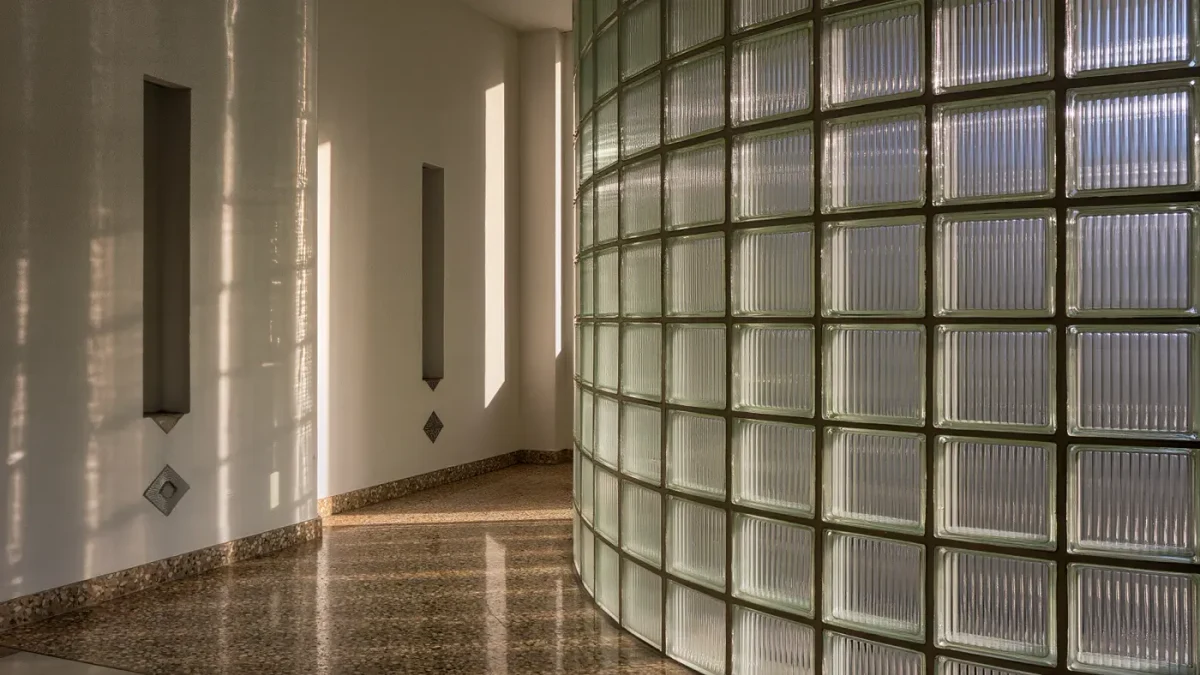
Glass block — hollow glass units laid in mortar like brick, transmitting diffused light while blocking view — has been installed, derided, demolished, and reinstalled in roughly forty-year cycles since its industrial debut in the early twentieth century; the Libbey-Owens-Ford and Corning-era products of the 1930s made it an Art Deco signature, the 1970s–80s put it in dentist offices and shower walls, and the 2020s have it reappearing in design publications as a privacy-and-light material for bathrooms and street-facing rooms. The block survives fashion because it solves a permanent problem better than anything else: it moves daylight through a wall while keeping the wall a wall.
The material's persistence is functional; only its reputation is cyclical.
What does glass block actually do?
Four technical jobs. Borrowed light: a glass-block panel transmits roughly 60 to 80 percent of incident light (clear patterns at the top of that range) — enough to daylight an interior bathroom from an adjoining room. Privacy: the standard patterns blur recognition beyond silhouettes at close range, achieving privacy without curtains that would block the light. Security and durability: a mortar-jointed glass panel resists impact better than plate glass and cannot be cut out of a wall quietly — one reason basement window wells got it historically. Thermal and acoustic separation: the hollow, partially evacuated block insulates better than single sheet glass and deadens street noise modestly — a real function on a first-floor urban window.
A short history of the cycles
The type matured with machine production in the 1930s, when Streamline Moderne architecture adopted it for curved corner windows and glowing stairwells — the glow of an all-night diner or theater at midnight was often a glass-block wall. Postwar, it settled into industrial and institutional duty: factories, schools, showers. The 1980s ran the material into cliché (the mirrored-fitness-center era did it no favors), and the 1990s–2000s renovation wave ripped it out — the word "dated" itself seemed to be made of glass block. The 2020s return recontextualizes it: design press now photographs glass block in curated palettes — curved shower screens, amber-tinted panels, whole facade lights on restaurants and boutiques — reading the same material as retro-futurist rather than retro. Preservationists tracked the pattern through the Library of Congress's building surveys; fashion tracked it through Instagram.
Where does it belong in a house today?
- The windowless bathroom: the canonical use — a panel high on the shared wall borrows bedroom light, ending the exhaust-fan-lit cave.
- The street-facing bathroom or stairwell: light without exposure, no drapery to mildew.
- The basement egress-adjacent window: security glass that still passes light into a rec room.
- The entry sidelight: light at the front door without the security trade of clear glass.
Where it does not belong: anywhere a view is the point (the ocean is not improved by pixelating it), anywhere the design intends crisp minimal glass — block's module and mortar joints are the aesthetic, take it or leave it — and load-bearing applications it cannot perform (it is infill, not structure; panels need the frame and restraints standard details provide).
What do installation and maintenance really involve?
Modern glass block installs two ways: traditional mortar with reinforcing and frame anchors, or the silicone-and-spacer track systems designed for DIY panels up to a size limit. Both want a framed, restrained opening — thermal movement and wall movement are the enemies, and the old failures (cracked panels, weeping joints) were usually detail failures, not material ones. Curved walls, the material's signature trick, are a mason's art. Maintenance is nearly nil: non-porous, no grout haze if detailed well, cleanable with anything glass tolerates — which is precisely why hospitals and pools loved it. Budget mid-range pricing per panel installed, with curved and colored work priced as specialty.
Is the comeback durable or a trend?
The honest read: the current design moment will pass, and the material will again be declared dated by people photographing bathrooms with borrowed light. But the underlying chemistry of the case — light plus privacy plus security plus cleanability — does not age. The 1930s diner, the 1970s shower, and the 2020s curated bathroom were all solving the same equation. Install it where that equation is genuinely yours to solve, and the fashion question answers itself: the panel will read as a choice the day it is built and a choice again in twenty years — the middle years are just the fashion cycle doing its laps.
FAQ
Is glass block outdated?
Its reputation cycles roughly every few decades — Art Deco origin, 1980s cliché, 2020s revival — but the function (daylight with privacy, security, low maintenance) never stopped working. Whether it reads dated depends on context and detailing more than the material itself.
Does glass block provide privacy in bathrooms?
Yes — standard diffuse patterns blur everything beyond vague silhouettes at close range while transmitting most light, which is why windowless-bathroom light borrowing is its classic residential use.
Can glass block be structural?
No — panels are non-loadbearing infill requiring framed, restrained openings with proper reinforcing or track systems. Used correctly, they resist impact better than sheet glass; asked to carry loads, they crack.