Masonry repair costs are driven less by the brick than by the mortar between it. The units themselves — brick, stone, concrete block — can last a century or more. The mortar joints holding them together are the part that wears, and repointing them is the repair most owners eventually face. The longer the work is deferred, the more of the wall it touches, and the higher the bill climbs.
There is a second qualification to put up front. Almost nothing in this article can be priced from a general guide, because masonry repair is priced by the wall: its height, its access, its climate, and how deep the damage runs. What a guide can do is explain what fails, in what order, and why some repairs stay small while others swallow a facade. That is the difference between a maintenance line item and a capital project.
What actually fails first in a masonry wall
Start with the anatomy. Masonry is the craft of building with brick, stone, or concrete block bound together by mortar, and the two parts age very differently. As Wikipedia's overview of masonry notes, it is generally a highly durable form of construction, but the materials, the quality of the mortar and workmanship, and the bonding pattern all affect how durable the whole assembly turns out to be. Read that sentence again with a cost lens: two of the three variables it names — mortar and workmanship — belong to the joints, not the units.
Water is the mechanism behind most of it. Mortar is softer than brick by design, so it absorbs the movement and the moisture that would otherwise crack the units. Over years, that trade does its work. Joints erode, hairline gaps open, and water finds them. Once water is inside the wall, freeze-thaw cycles do the rest: the same source explains that extreme weather can degrade masonry through expansion and contraction forces tied to freeze-thaw cycles. In a cold climate, each winter widens the gap a little. In a wet, warm one, the enemy is less dramatic — sustained damp, biological growth, and mortar that slowly turns to sand. This connects to our earlier piece, What makes a building Brutalist, and why people pay to live in them.
The units are the last thing to fail, which is why a wall can look broadly fine and still owe decades of joint work. Individual bricks that spall (flake apart in layers after saturating) or crack are the exception, and they usually trace back to water entering somewhere else — a failed gutter, a bad flashing, a crack nobody sealed. Fixing the brick without fixing the water source buys a wall one more cycle of the same problem.
When does a wall need repointing, and what does it involve?
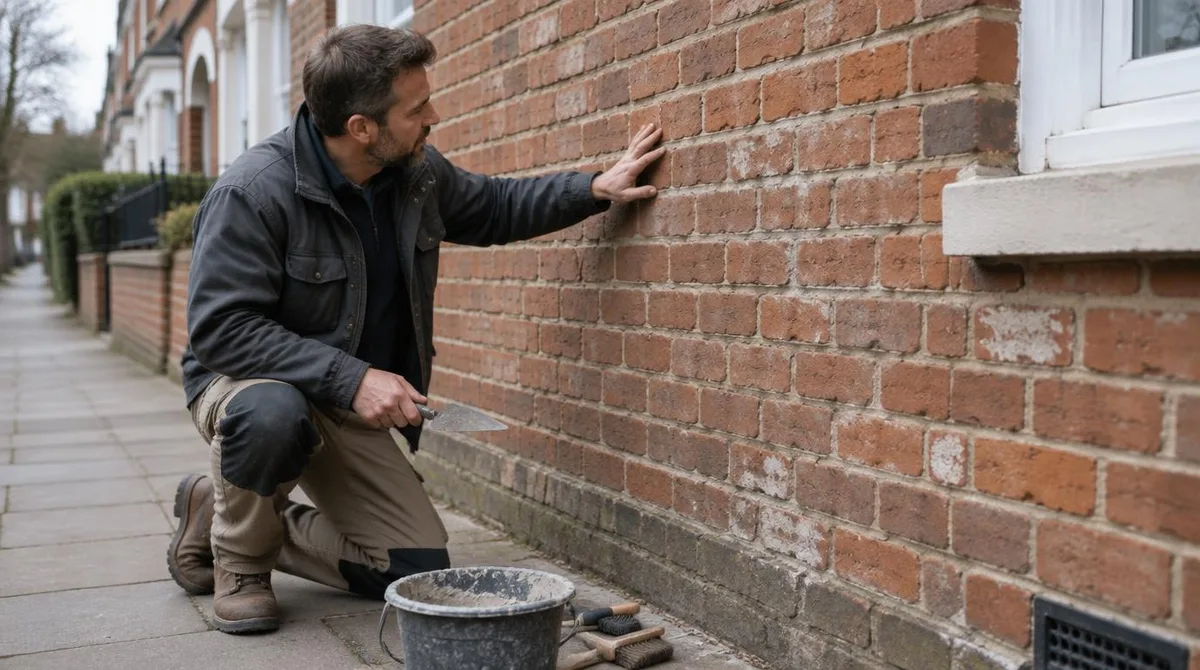
Repointing is the process of raking out deteriorated mortar and packing in fresh mortar. It is the bread-and-butter repair of masonry maintenance, and most solid brick buildings need it at some point in their first fifty to a hundred years — a range, not a schedule, because climate and original workmanship set the clock. The tell-tale signs are visible from the ground: joints that are recessed or crumbling, mortar that powders when you rub it, hairline cracks following the joint lines rather than crossing through the bricks.
The work itself is slow and skilled, which is where the money goes. A mason rakes out the old joint to a consistent depth, cleans it, dampens it, and packs in new mortar in layers. The mortar mix matters more than most owners expect. Old walls were built with soft, lime-based mortar; repointing them with a hard modern cement mix traps moisture in the bricks and can accelerate the very spalling the repair was meant to prevent. Compatibility, not strength, is the specification that matters. For related coverage, see Concrete spalling and carbonation: why modern buildings age faster than expected.
Cost-wise, repointing is quoted by area or by the square foot or meter of wall, with three variables dominating: how much scaffolding the height demands, how deep the raking has to go, and how much of the wall is affected. A few failed joints at ground level is a handyman-scale job. A full facade repoint on a three-story building, with scaffold hire and mortar matching, is a different order of spending entirely. That spread is why no honest guide quotes a single number — the same wall can carry a cosmetic repair or a structural one depending on when someone acts.
Which repairs stay cosmetic, and which turn structural?
The dividing line is usually whether water has reached past the joints. Cosmetic-tier work includes isolated joint repointing, replacing a handful of spalled bricks, cleaning biological growth, and sealing small cracks. These are maintenance jobs. They preserve the wall's weather resistance and its appearance, and they are priced like labor plus modest materials.
Structural-tier work begins when the wall itself has moved. Watch for these patterns, each of which changes the scope and the budget:
- Stair-step cracks through the joints in a staircase pattern, often a sign the wall or its foundation has shifted.
- Bowing or leaning walls, where a section of masonry has come out of plane — this can call for wall ties, anchors, or rebuilding a section.
- Lintel or arch failure over windows and doors, where the support above an opening has cracked or dropped.
- Widespread spalling across a facade, which can mean the wrong mortar was used in a past repair and the units are now the failing part.
The last one deserves a note. As the Wikipedia overview explains, masonry walls rely on mortar and the friction between interlocking units for strength, and many older walls are load-bearing — the brick is the structure, not a skin over it. On a load-bearing wall, deferred joint maintenance is not a cosmetic deferral at all. It is deferring structural repair, and the eventual bill reflects that. On a modern veneer wall (a single layer of brick over a wood or steel frame), the stakes are lower for the brick but the water that gets past it can rot the frame behind — a different failure with a different contractor.
How does climate change the bill?
Geography sets the tempo of masonry decay. Freeze-thaw is the fastest clock: in climates with hard winters, water in a joint expands as it freezes and pries the wall apart a fraction at a time, so joints fail sooner and repointing cycles come around more often. Wet maritime climates run a slower clock — damp, salt, and biological growth erode mortar and stain stone without ever freezing. Dry climates are gentlest on the units, though sun and thermal movement still work the joints loose over decades.
Regional supply matters more than most people guess. Brick and stone are heavy, cheap-to-make but expensive-to-ship materials, and local suppliers shape both the palette and the price of repairs. Packer Brick, a third-generation family masonry supplier serving the Dallas area, describes its inventory of concrete masonry blocks, mortars, wall ties, and lintels as the essentials for matching local work — and that list is telling. Wall ties and lintels are the parts that fail or corrode in older walls, and finding a compatible match locally is often the difference between a one-visit repair and a special-order wait. Where you live determines which of those parts are on the shelf.
Our analysis, for what it is worth from the evidence: the cheapest masonry repair is always the one done at the hairline-crack stage, because at that point the work is joints only. Every year of deferral converts joint work into unit work, and unit work into structural work. The curve only steepens.
Practical steps: budgeting for a masonry facade
Since no guide can price your wall, here is how to get to a number you can trust:
- Walk the perimeter once a year. Look up at the joints, the lintels, and the base of the wall where moisture collects. Photograph anything new so you can compare year over year.
- Fix water management first. Gutters, downspouts, and roof flashing direct the water that destroys joints. Repairing them is cheap relative to any masonry work, and it protects whatever masonry work you do pay for.
- Get a mason's assessment, not a quote, first. A good mason will tell you whether the problem is joints, units, or structure — and those three answers lead to three different budgets.
- Ask what mortar they will use. On an older building, the compatibility question is the single best test of whether a contractor knows the work.
- Stage the work. Repointing can usually be done in phases, worst-facing wall first, which spreads the cost without letting the worst section deteriorate further.
What the evidence establishes is the shape of the spending: mortar and labor dominate, water is the enemy, and timing sets the tier. What no general source can establish is your number — that comes from a mason standing in front of your wall, which is the one step no article can substitute for.
What masonry maintenance comes down to
Brick and stone earn their reputation for durability, but the fine print is the joints. Masonry repair costs track a simple progression: joints fail first, units fail next, structure fails last — and each stage costs a multiple of the one before. Owners who treat the facade as a maintenance item, not an inheritance, keep the work in the first stage. The wall, and the budget, both prefer it that way.