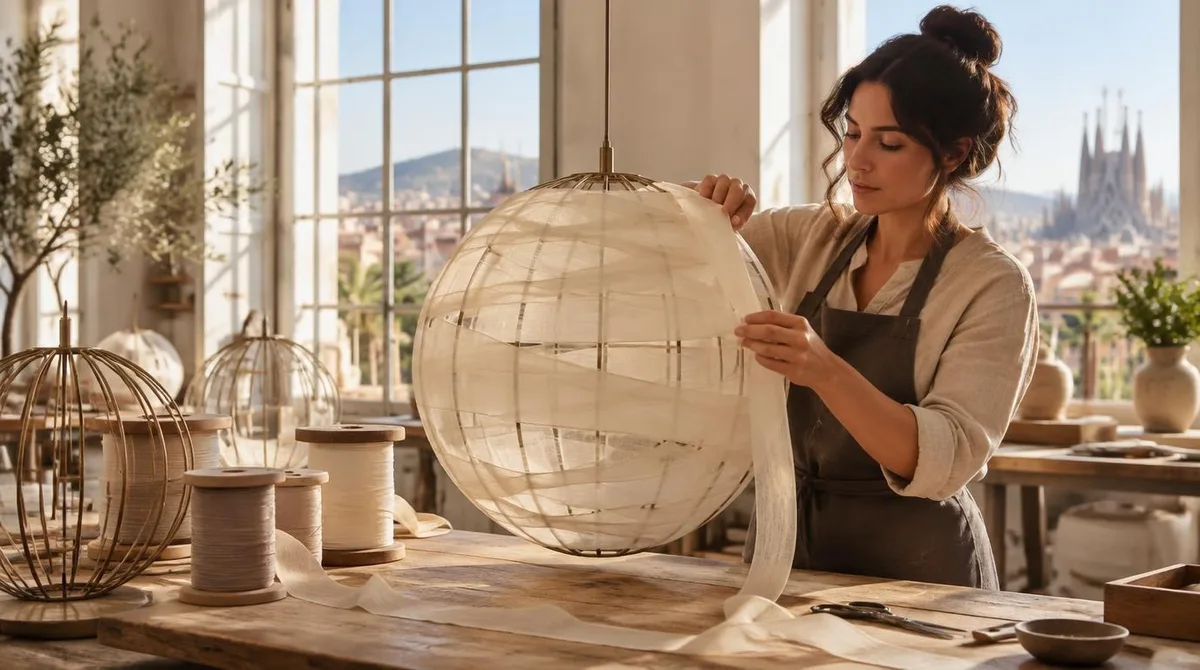
Bover, the Catalan lighting brand, marks its 30th anniversary in 2026, and its version of "handcrafted" comes with numbers attached. Wrapping a single Mos 03 pendant shade takes 590 meters of translucent ribbon and six hours of work, per the brand's own account. That is the claim worth reading closely: a lighting company that still prices its labor in hours, not units.
The brand was established by Joana Bover near Barcelona in 1996, pairing local artisanal heritage with LED technology, Interior Design reports. Its fixtures are described as illuminated sculptures meant to carry what the piece calls the Mediterranean's distinct natural glow into indoor and outdoor spaces. For anyone furnishing a lobby, a restaurant, or a living room, the interesting question is not the romance of it. It is what hand labor actually buys you in a finished room.
Hospitality design is where this kind of fixture earns its keep, because lighting does more visible work in a public room than almost any other material choice. This connects to our earlier piece, Hotel bathroom design tricks worth stealing for your own.
What does the handwork actually involve?
The signature technique is ribbon-wrapping, and it runs across many of Bover's collections. Master craftspeople who have been long on staff weld internal steel frames by hand, then bind bands of selected material around concentric metal rings. The weave is taut and layered, and that tension is what softens harsh glare into ambient radiance coming through the open weave's apertures.
Each product tests the process differently. The Mos 03 pendant needs its 590 meters of ribbon over six hours. The Mei 150 fixture demands 550 linear yards and two-and-a-half-hour working cycles. The Kando P111 outdoor lantern uses nautical cordage, tightly woven in an intensive ninety-minute interval, according to Interior Design. And the Dome chandelier, designed by Benedetta Tagliabue, is sewn together from 170 beechwood components with a precision the brand says makes them look machine-made.
That last detail is the honest tell. The goal is not visible roughness. It is hand control at a tolerance that reads as machine output — the opposite of the deliberately distressed look that passes for craft in a lot of hospitality procurement.
Why does hand labor matter in a finished room?
Here is the analytical read. In a hotel lobby or a restaurant at dusk, what people respond to is not the object but the light's texture. A tightly woven shade turns a hard LED point source into something diffuse and warm — the same principle that makes a linen lampshade feel different from a bare bulb. Bover's method is essentially an industrialized version of that oldest trick, with the weave itself as the diffuser.
There is also a durability argument, and the source makes it directly: the closely controlled "produced with care" approach is said to ensure the luminaires are durable and long-lasting. In hospitality, where fixtures run twelve hours a day and get cleaned constantly, longevity is not a luxury talking point. It is the difference between a light that anchors a room for a decade and one that gets swapped out in three years.
The sensory logic extends beyond the fixture itself. The way a public room feels has a lot to do with layered, low-glare light and honest materials — the same territory as the materials that make memory in a lobby. A woven pendant and a good material palette do the same job: they make a room feel specific rather than generic.
What should a homeowner take from it?
The transferable lesson costs nothing. Bover's shades work because the light source is hidden and the weave does the shaping. Anyone can borrow that: put the bulb where you cannot see it, and let a textured shade — fabric, cord, paper — do the softening. Readers following this should also see Hotel lighting has lessons for every room in your house.
It is also a reminder about what "handcrafted" should mean when you see it on a spec sheet. Bover's use of the word comes with a countable process — meters, hours, components. When a catalog claims craft without anything countable behind it, that is the freshly-painted-for-a-reason moment. Ask what, specifically, a person's hands did.
Where does a 30-year-old workshop go next?
The evidence here is a 30th-anniversary profile, not a roadmap, so the honest answer is: toward the same place it has been. The brand's formula — local artisanal heritage plus LED technology, established in 1996 and still central in 2026 — is a bet that hand production can scale slowly and survive. What remains unknown is how that math holds as demand grows; the source does not say. What it does establish is that the labor is real, it is measured, and it is the product. For a design audience, that is the story: not a lamp, but a production model that treats six hours of ribbon-wrapping as a reasonable unit of work.