Hotel bathrooms punch above their size because designers engineer them against a brutal checklist — clean in minutes, survive a thousand guests, photograph well, and feel luxurious at 6 a.m. The tricks that survive that gauntlet translate directly to homes: a walk-in shower with a half wall instead of a curtain, lighting at the face not the ceiling, niches instead of shelves, and a real place for the towel you actually use. Hospitality-design trade coverage through 2025 documents the industry's steady convergence on these moves across brand tiers.
What follows is the steal-list, ranked by cost. (This article publishes information, not construction advice.)
Why do hotel showers feel bigger than they are?
Geometry and a single move: the wet room. By waterproofing a continuous floor and letting the shower share the room's footprint behind glass or a half-wall, the designer deletes the shower's visual borders — the enclosure, the curb, the curtain — and the eye reads one room, not two boxes. The drainage trick underneath is a gently sloped floor to a linear or center drain, invisible under tile. At home, a curbless entry costs real money at renovation time (sloping, waterproofing, pan work) but it is the single highest-impact hotel move for small bathrooms, and it doubles as aging-in-place design — no threshold to trip on at 80.
What is the lighting secret?
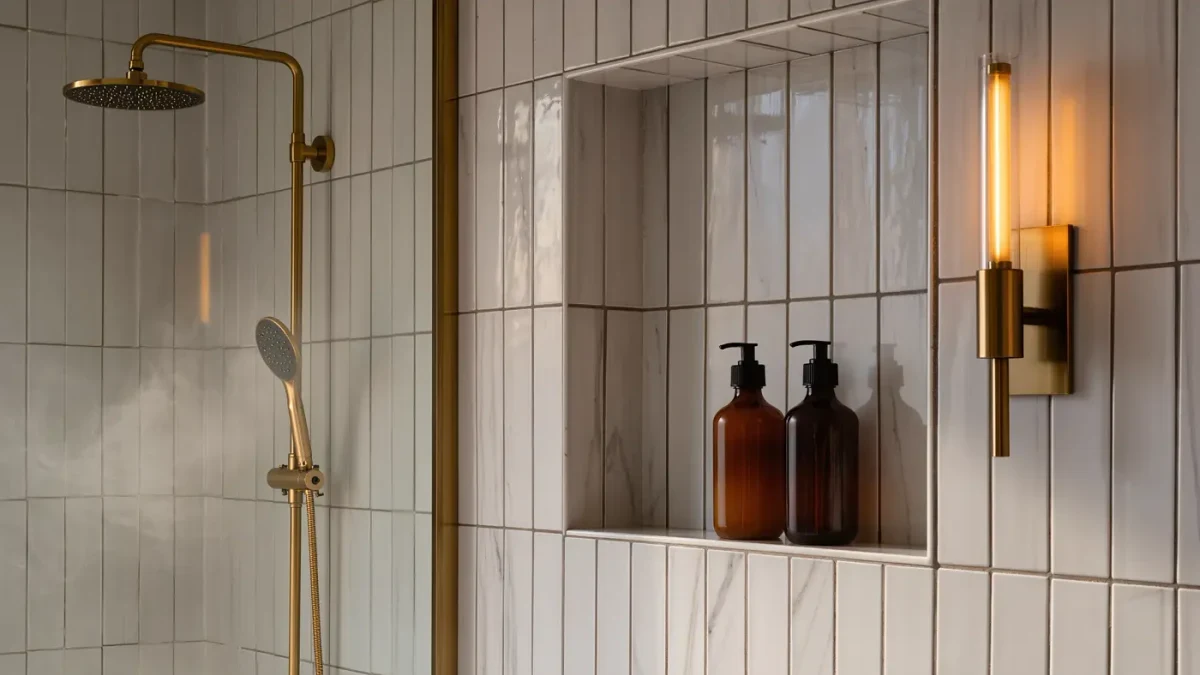
Hotels layer light and put the first layer on your face. The formula: warm (2700–3000K) vertical sconces or an illuminated mirror at head height, a ceiling source only for cleaning, and a low night-light path so a 3 a.m. visit does not require full brightness. The home mirror lit from above by a single fixture — the standard American bathroom since the 1980s — is the anti-hotel: it casts eye shadows and makes the room read institutional. Swapping a bar light for two vertical sconces is an afternoon's electrical work and the cheapest hotel effect available.
Where does all the stuff go?
Niches. A recessed shelf in the shower wall — tiled, drained, sized for real bottles — is the hotel's answer to the shower caddy, and at home it kills the clutter that makes bathrooms read small. Behind the mirror, a recessed or mirrored medicine cabinet swallows the daily kit; hotels use full-mirror cabinets for exactly this reason. The open-shelf look photographs beautifully and collects dust terminally; hospitality's designers, who clean for a living, gave it up years ago.
What materials actually wear like a hotel?
| Surface | Hotel verdict | Home translation |
|---|---|---|
| Large-format porcelain | Standard — fewer grout lines, fast cleaning | Use on floor and walls; wood-look versions read warm |
| Natural stone | Luxury tier only — seal and maintain | Accent, not shower floor |
| Solid-surface counters | Workhorse — seamless sinks | Integral sink = no caulk line to mold |
| Chrome / brushed fixtures | Timeless, replacable | Trend finishes date faster than the valve lasts |
What are the small hardware moves?
- A towel hook at shower-exit height — hotels learned that guests hang the in-use towel on the nearest hook; homes fight this with one bar for four towels.
- Two shower heads or one good one — a quality 8-inch rain head beats a jet panel nobody maintains.
- Backlit or lighted mirror on a motion sensor for night mode.
- Pocket or outswing door — reclaim swing space in rooms under five square meters.
- Heated floor mat zone where feet land — cheaper than warming the whole floor.
What should a homeowner skip?
The glass-box wet room with no ventilation plan (mold is a humidity problem before it is a design problem); the freestanding tub in a room too small for one (it becomes a laundry basket with ambitions); the wall-mounted faucet on an unreinforced wall; and anything requiring hotel-grade maintenance — rain heads need descaling, stone needs sealing, frameless glass needs squeegeeing. Hotels have housekeeping departments; you have Saturday.
How do I sequence a steal-list renovation?
Pick one hero move per budget band: paint plus sconces and a mirror cabinet transforms a bathroom for hundreds; the niche plus curbless shower is the mid-band renovation worth doing properly with waterproofing inspected before tile; the full wet-room rework is a design-and-permit job. In every band, spend first on the invisible hotel virtue: extraction. A quiet, correctly sized fan on a timer does more for daily luxury than any fixture catalog.
FAQ
What is a wet room bathroom?
A fully waterproofed bathroom where the shower is open to the room, with a sloped floor draining the whole space — no tub, curb, or enclosure. It maximizes small footprints and provides barrier-free access, but requires professional waterproofing.
Why are hotel bathrooms so bright at the mirror?
They light faces, not rooms: warm vertical sconces or backlit mirrors at head height, layered with dim ambient sources. Ceiling-only light casts shadows that read as harsh; the fix is fixture placement, not more watts.
Are curbless showers worth it at home?
For most renovations, yes: they read larger, clean faster, and serve aging-in-place needs. Budget for proper floor sloping and waterproofing — the tile is the cheap part of a curbless conversion.