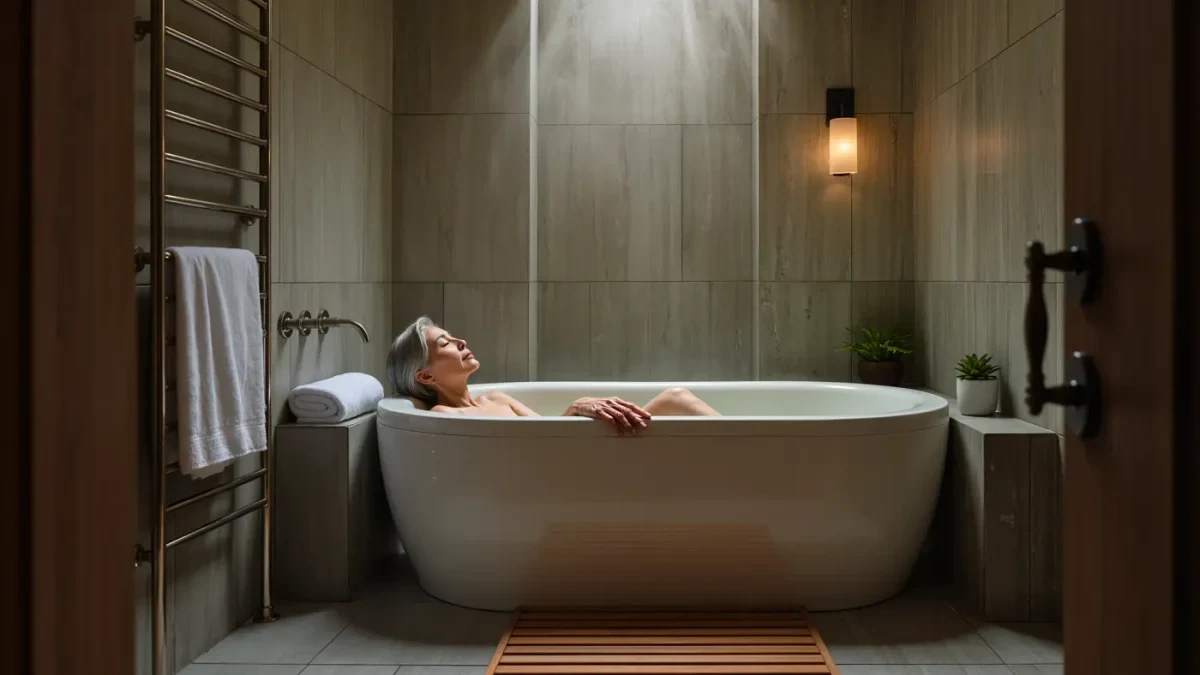
Commercial spas produce their calm deliberately: heat held within a degree or two, water choreographed from sound to silence, materials chosen for how they feel at skin temperature, and a spatial sequence that separates you from the world in stages. Design guidance for wellness facilities — including industry standards on thermal-suite temperatures, which place Finnish saunas around 150–195°F and steam rooms at full humidity near 110–120°F — treats each of these as an engineering variable, not a mood. The surprise for homeowners: most of the effect scales down. A standard bathroom cannot be a spa, but it can borrow the spa's operating manual.
Here are the principles, translated to house scale. (This article publishes information, not health advice.)
Principle 1 — Sequence, not square footage
Spas never put the street and the treatment in the same room: you pass through changing, transition, and quiet zones, each lowering stimulation. The home translation is a threshold ritual — even a curtain or a pocket door between the bathroom and the hallway creates one boundary your nervous system can register. Inside, arrange the room so the bath or shower sits farthest from the door, at the end of a path: the walk is the wind-down. Where space allows, a partial screen or a vanity kneelength wall can break a small bathroom into two readings — active zone (sink, mirror) and calm zone (tub) — which is half the spa effect for the price of a stud wall.
Principle 2 — Heat as a constant
Spa comfort is thermal comfort: cold tiles are the anti-spa. The moves, by cost: heated floor in the zone where you stand (mat or cable, cheapest where new tile is already planned); a towel warmer that actually heats the room's second-most-touched object; moisture-warm air via a correctly sized fan run on delay — note the spa inversion of normal bathroom practice: spa design wants warmth retained and humidity managed quietly, so a low-speed fan on a timer beats a roaring extractor that chills the room. Steam, the spa's signature medium, comes home as a steam generator only with a fully enclosed wet-zone and professional waterproofing — the one translation that stays a professional job.
Principle 3 — Water as sound design
In a spa, filling a tub is a performance; draining it is inaudible. At home, the translations are mechanical and cheap: a deep-fill tub spout positioned to strike water, not porcelain; a rainfall shower head sized to the water pressure (a 10-inch head on weak pressure delivers a drizzle, not rain — check pressure first); and sound masking where the bathroom abuts living space — dense insulation in the shared wall and rubber gasketing at the supply pipes, the two fixes that remove the spa-killing sound of the house's plumbing.
Principle 4 — Materials at skin temperature
Spas select surfaces by touch: teak and stone that stay warm, matte finishes that forgive. The home short-list: wood (teak, cork) on floors and bath mats where feet land — warm underfoot and soft acoustically; stone or stone-look porcelain in the wet zone, but honed rather than polished, both for the feel and the slip; textiles promoted to permanent status — a real linen shower curtain, a heavy cotton robe on a hook, towels stored within the warm zone. The rule of thumb: every surface your body touches should be warmer, softer, or both, compared with the bathroom you had before.
Principle 5 — Light down, not up
Treatment rooms light at low level and warm temperature — candles at dinner, not surgery. The home version: dimmable warm sources (2700K) at tub height, one small light path for safety at night, and blackout on any window; spa lighting is the easiest of the borrowed systems because it is portable — sconces, lamps, and dimmers rather than renovation.
What should a renovation prioritize?
If the bathroom is coming apart anyway, spend in this order: waterproofing and ventilation (the invisible spa), heated floor in the standing zone, a tub you will actually use (soaking depth over bubbler features — spa soak tanks win by depth and stillness, not jets), and the threshold/sequence change. If it is not coming apart, the spa arrives by objects: towels, mat, robe, dim lamp, one plant that likes steam. The industry's open secret is that the calm is choreography more than construction — and choreography ships in a shopping bag.
FAQ
What makes a bathroom feel like a spa?
Thermal comfort (warm floors and towels), warm low lighting, soft acoustics, natural materials at touch points, and a sense of sequence from door to bath. Most of these are achievable with fixtures and objects rather than construction.
Is a steam shower worth it at home?
Only with professional design: a sealed enclosure, vapor-proof waterproofing, a dedicated generator, and ventilation — a retrofit steam unit in a standard shower breeds moisture problems. Enjoy it where it was planned from the start.
What temperature should a sauna or steam room be?
Typical wellness-industry ranges: Finnish sauna 150–195°F with low humidity; steam room near 110–120°F at 100 percent humidity. Home units should follow manufacturer and electrical-code guidance.