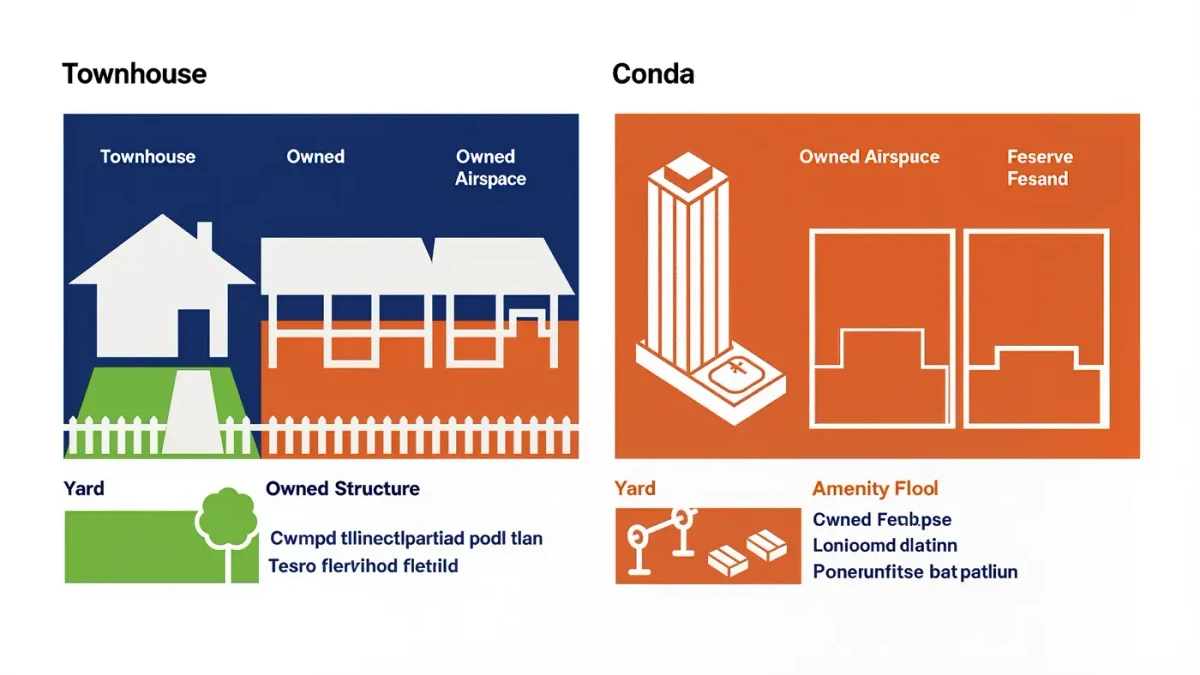
A townhouse is a multi-floor home sharing walls with neighbors but standing on its own land parcel — you typically own the structure and a small yard, and answer for its roof. A condo is a single-level (usually) home inside a shared building — you own the interior airspace, and a homeowners association owns and budgets the structure. Census housing data through the 2020s shows both types gaining share as buyers trade single-family yards for walkable locations, and the choice between them is less about price than about which responsibilities you want to hold.
The honest comparison is a list of trades — here it is.
What does a townhouse do better?
Control and volume. You pick the roof timing, the paint, often the HVAC — no association vote between you and a leaking skylight. The stacked floors give a spatial privacy condos struggle to match: nobody's footsteps above your bedroom if you're on the top floor of your own box. Townhouses often include real outdoor ground — a patio, a patch for a grill — and in for-sale product, pet and renovation rules tend to be lighter than condo declarations. In many metros, dollar per square foot also favors townhouses; the same budget buys 15 to 25 percent more interior area a few blocks inland from the condo towers.
What does a condo do better?
Effort and services. Exterior maintenance, snow, roofing, insurance on the structure — all pooled, all someone else's Saturday. Buildings add amenities no townhouse gets: gym, pool, package room, sometimes a doorman, and increasingly coworking floors. Single-level living suits aging in place and everyday ease; the elevator does the stairs' job. Security is structurally better — controlled entry beats a street-facing door. And location: condo product clusters in the densest, most walkable blocks where townhouse land has long been priced out.
What are the hidden costs on each side?
| Cost | Townhouse | Condo |
|---|---|---|
| Monthly fees | Small HOA if any (common areas) | Substantial; rises with building age & insurance |
| Roof / structure | Your bill, your timing | Reserve-funded — or special-assessed |
| Insurance | Full homeowner policy | HO-6 walls-in policy plus master via fees |
| Surprise risk | Concentrated, yours to schedule | Diluted but pooled — politics included |
| Utilities/mechanics | Your systems, your efficiency choices | Shared systems, sometimes included in fees |
Which lifestyle questions decide it?
Ask five. Do you want a yard, even a small one — for a dog, a grill, a garden? Townhouse. Do you travel often or live part-year elsewhere? Condo's lock-and-leave wins. Do stairs worry you across a ten-year horizon? Condo, or a townhouse with a ground-floor primary suite. Do you care about controlling your renovation calendar? Townhouse — condo boards approve, limit, and schedule. And do you read budget documents for pleasure? If not, either way, hire someone who does: the townhouse roof and the condo reserve study are the same animal in different enclosures.
What about resale?
Both types sell into the same macro forces: walkable-location demand, lock-in-constrained supply, aging buyers trading down from houses. Condos carry the sharper resale variables — fee level, reserve funding, litigation, and in some markets, unsold developer inventory in competing towers — all of which a buyer's attorney will read. Townhouses carry the classic house variables — roof age, systems, structure — plus HOA rules for the small association if one exists. In appreciation terms, neither type reliably outpaces the other; condition, location, and the quality of the governing paperwork are the actual predictors.
How do I tour each like a professional?
In a townhouse: look up (roof plane from the alley), listen sideways (the party wall at 7 p.m.), and check who pays for what common. In a condo: read the last two budgets, the reserve study's percent-funded figure, and the minutes for the phrase special assessment. In both: run the commute at rush hour and the grocery trip on foot. The floor plan sells the visit; the monthly math sells the decade.
FAQ
Is a townhouse cheaper than a condo?
Often per square foot, yes — townhouses frequently deliver 15–25 percent more interior area for the same budget in comparable locations. But you own the roof and systems, so lifecycle costs shift from monthly fees to occasional large bills you schedule yourself.
Do townhouses have HOA fees?
Many do, but small — covering shared fencing, landscaping, or a tiny common area, typically a fraction of condo fees. Some fee-simple townhouses have no association at all; the plat and declaration tell you which you are buying.
Which is better for a first-time buyer?
Whichever matches your honest answers on yard, stairs, travel, and tolerance for association rules. Condos lower the maintenance learning curve; townhouses build equity in the skills — and costs — of actually owning a structure.